The Alpine Network of Protected Areas







BfN-Skripten N°273 : Implementing a Pan-Alpine Ecological Network - A Compilation of Major Approaches, Tools and Activities
File: Download
SZENEALPEN 90: Schengen for Flora and Fauna
Why only connected habitats stay diversified
CIPRA, March 2009.
Available in French, Italian, German and Slovenian (No English version).
Ce document s'adresse aux personnes qui envisagent de construire ou de réhabiliter une maison en y intégrant des dispositifs solaires. Il est le fruit des échanges menés dans le cadre d'un programme européen avec notamment les Parcs des Écrins et du Queyras, le Conseil général et la CAPEB des Hautes-Alpes.
This section includes all the PowerPoint presentations shown during the tour.
You will also find links to websites that can provide more information on energy efficient buildings.
Please note that the presentation of Dominique Gauzin-Müller is an abstract of another projection which lasts 90 min.
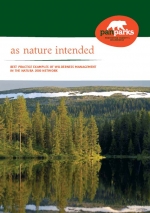
As nature intended: best practice examples of wilderness management in the Natura 2000 network.
Edition: PAN Parks Foundation, 2009
The 11 best practice examples of various European national parks collected in this publication describe different aspects of wilderness management in various habitat types also defined by Natura 2000 codes. Through this collection we demonstrate that wilderness management approaches and techniques such as non-intervention management may play a crucial role in the management of protected areas in Europe, and that they are applicable approaches in the Natura 2000 network, where the major objective is to protect ecosystem dynamics.
With these and many more examples, this publication is intended to serve as a useful source of information for policy makers of the European Commission and national institutions, and at the same time wishes to offer feasible non-intervention management techniques for protected area managers directly. We hope that the examples collected will encourage them to consider the application of this versatile management approach in order to enhance and strengthen wilderness protection in Europe.
Pauchard A. et al. (2009).
Frontiers in Ecology and the Environment 7, 479-486.
Mountain Invasion Research Network
Most studies of invasive species have been in highly modified, lowland environments, with comparatively little attention directed to less disturbed, high-elevation environments. However, increasing evidence indicates that plant invasions do occur in these environments, which often have high conservation value and provide important ecosystem services. Over a thousand non-native species have become established in natural areas at high elevations worldwide, and although many of these are not invasive, some may pose a considerable threat to native mountain ecosystems.
Here, we discuss four main drivers that shape plant invasions into high-elevation habitats: (1) the (pre-)adaptation of non-native species to abiotic conditions, (2) natural and anthropogenic disturbances, (3) biotic resistance of the established communities, and (4) propagule pressure. We propose a comprehensive research agenda for tackling the problem of plant invasions into mountain ecosystems, including documentation of mountain invasion patterns at multiple scales, experimental studies, and an assessment of the impacts of non-native species in these systems. The threat posed to high-elevation biodiversity by invasive plant species is likely to increase because of globalization and climate change. However, the higher mountains harbor ecosystems where invasion by nonnative species has scarcely begun, and where science and management have the opportunity to respond in time.
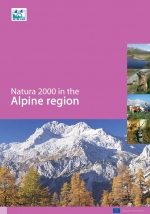
Natura 2000 in the alpine region
Natura 2000 in the alpine region Natura 2000 in the alpine region Official Publication of the European Communities, 2006, 12p.
The Living Planet Report is helping raise public awareness of the pressures on the biosphere and spreading the message that “business as usual” is not an option.The report contributes to fostering action, as what gets measured gets managed.
Here you can find all the presentations of the international conference from the 22nd October 2010.
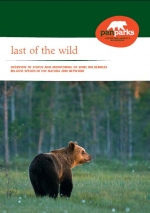
Last of the wild: overview of status and monitoring of some wilderness related species in the Natura 2000 network.
Edition: PAN Parks Foundation, 2009
By providing a description of the management and monitoring practices of various protected areas, with regards to chamois, ibex, brown bears, lynx, wolves and white-tailed eagles in its new publication, the PAN Parks Foundation aims to argue for the need for a non-intervention management approach that will ensure healthy and stable populations of these – and other – important wilderness species. In addition, we hope that the present selection of monitoring experience will serve as inspiration to many nature conservation professionals in their handling of wilderness habitats and species around Europe.
If you have comments or questions concerning the publications or the PAN Parks Foundation, please contact Edit Borza, Communications Manager at eborza@panparks.org or visit
www.panparks.org
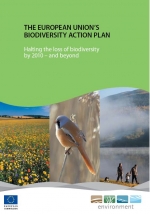
The European Union’s biodiversity action plan: Halting the loss of biodiversity by 2010 – and beyond.
Official Publication of the European Communities,